One Battle After Another
It has been roughly a month since I went to watch PTA's One Battle after Another. I wanted to quickly highlight my initial feelings and the general significance I found the film to have. This was the first film I had watched after the downloading of and regular interaction with LetterBox and as such it became an important tool of analysis. Letterbox provides the film watcher with an opportunity to join into a discussion of the film, not by critics, but by what we call the multitude, the mass. It provides what I find to be an impressively adaptive pulse of the population (or at least a certain segment of the population whether this segment should be treated as a genuine sample is discussion for another time). The fixation on certain comedic elements in the one liners, the obsessions of the often critical multi paragraph postings, the frequency of the all caps, emoji embellished responses. These all provide a colorful context, a chamber in which the film can be experienced wholly anew. That is why I find it utterly delightful to doom scroll through the reviews only after I have finished the film. It is a secondary stimulation, an attempt to preserve the high achieved during the film, to draw it out and stretch it as long as possible.
Now into the film itself. The primary watching. The film presents a future (or really current) America that is in the midst of a revolutionary uprising. There is government which has unleashed the military on top of its own civilians to round up, prosecute, and deport "wetbacks" (immigrants). The real motivations behind this round up are left unexplained but the force with which it is done is made ever so clear by the those carrying out the task. Throughout the film the officers of the law, the executioners, move with despotic freedom, carrying out missions against the populous with an inhumanity and an ease one is used to expecting in wars waged on foreign grounds. Puzzlingly we never truly understand the scale of the conflict within the nation. For some it seems a life-death struggle and for others merely a minor disturbance. The counter force to this violence is the revolution. The revolution is made up a diverse force containing blacks, whites, hispanics in the service of those oppressed. There is an implied racial divide though between the military forces and the revolutionaries as the head radical is a black women and the head military officer a white man. These two forces confront each other throughout the film in violent and perverse contexts. There is a weird sexual tension depicted between the two which sets up for me the most provoking aspect of the film: the foolishness, brashness and moral uncertainty of revolution.
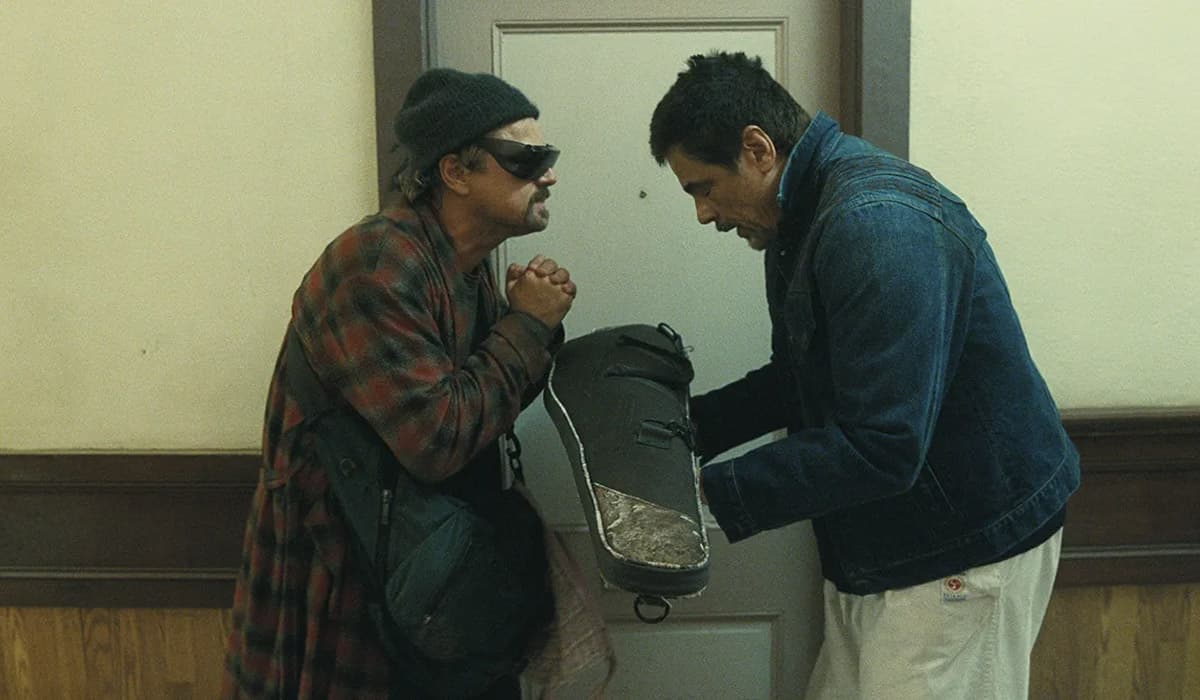
The protagonist, Bob Ferguson, is what I call the lousy revolutionary. Played by Leonardo DiCaprio, he captures the personality of someone more interested in the characters of the revolution and less about the actual cause. He follows it out of romantic necessity and not out of personal belief. The elements of the revolution most attractive to him are its people, more than its cause. This makes him a charming and relatable main character as the moral righteousness of the revolution is questioned. The revolutions righteousness is utterly dismantled in the chaotic sequence of scenes where the head revolutionary kills a security guard while her band is robbing a bank. An innocent cast away with the same ease, maybe more, than the forces they are opposed to. Bob, meaningfully separated from the movement, is not grouped in with this violent act and in fact is further separated as he is forced, through the capture and abandonment of his partner (the head revolutionary Pervidia Beverley Hills), to care for their only child shortly after Perfidia ratted out all her companions showing that Bob's cause was his family, his partner's was herself. As movies about revolution go, it was a peculiar choice to frame the head of a revolution as one willing to sacrifice the movement for her own freedom. It debased the quality of the revolution and put into question the righteousness of the movement. The revolution from early on was tainted, subverted by a white pestilence in the form of Colonel Lockjaw and his perverted intentions. He, with complete knowledge of the revolutions actions, actively chose to ignore their work despite it being his chief concern, as long as Perfidia was willing to fulfill his sexual fantasies (erotic gun play being an comically apt perversion for an officer of the law). Perfidia's entire operation is corrupted by this entanglement.
Even less important figures in the revolutionary come across as unserious, intolerant and idiotic; best seen when Bob tries to answer what the password is. The comically woke comrade of a fierce resistance force on the line complaining of We, the audience, are actually compelled to dismiss the revolution (or at least its embodiment in the French '75) as folly, as fruitless and disenchanting, a violent aside causing chaos for the sake of chaos; a just cause pursued unjustly.
The introduction of Benicio del Toro's character, Sergio, provides the audience with a counter example to the French '75. We see an alternative to violent force. A group working in the shadows, with impressive degrees of infiltration into the enemies operation, yet without the flashiness and flamboyance of pussy cat and her crew. There effect seems to be great, running an underground tunnel for migrants, a "latino Harriet Tubman" situation. Even the personality of his character reflects a less concerned yet just as determined character. Often enjoying the moment, taking his time in contrast to Bob's frenzied antics and frequent shouting. An air of cool and collectedness; of utter composure. A fearless character never brought to erraticism. When he goes to find his gun (a weapon discharged without regard in the open while pregnant by Perfidia) is far underneath Del Toro's bed, so far he needs to make multiple attempts at it to pull it free. His cause is the same, his means different. Is this the revolutionary we are asked to sympathize with?
Sean Penn's character, Steven J. Lockjaw, the head of the military operation, plays a deeply conflicted character, uncertain of his racial responsibilities, torn between allegiance to his white comrades and his sexual desires (and perhaps even a genuine respect) towards black women. The white overlords which are the only ones cast in a dark and sadistic light, end up killing Sean who in his last moments shows the signs of a boy who after just receiving his deserved gifts, basking in the glory of his hard work and dedication, has them mercilessly snatched away. The moments leading up to his assassination show a tender Colonel. The overwhelming waves of pity were a surprise. I would say we were never truly convinced of his hate; it was an outward appearance exercised only for the advancement of rank. He represented what I found to be an interesting precondition of most forms of hatred; a simultaneous rejection and fascination, a clear dichotomy of internal character. A representation of the conflict between socially upheld constitutions and what we internally hold to be undeniable truth. It is in the corrupt and defiled society where these two lie in direct opposition where we are told to hate things which our bodies can only desire, where these types of characters are created. There is a tension which makes itself known and surfaces in the peculiarities of his character; his painfully scrunched face, his lopsided tightening gait and the short gravelly spurts of dialogue as if he forces every word out through an ever constricting throat. His hatred is an externally enforced obligation rather than a personal constitution.
I found the choices made around the military interesting. Particularly the scene awarding Sean Penn his medal; a ceremony of tiny proportions in a windowless conference room. It is difficult to place the scale of general conflict. The military at times feels omniscient and at others not even present. The military is a faceless force working under the guises of a few faced characters; characters whom seem to be only pegs in a larger wheel. Ever acting, but never being directed. Their actions never come across as overtly sinister masterminded plots. They are just there, the external Other, applying force in the name of another; a name not known.
Lastly, the final scene with Chase Infiniti's character, Willa, and Bob, a scene that combined with the emotion evoking score, brought me to the brink of tears, asked a question. A question the audience is forced to answer. A question of approach. How we choose to fight our battles and in what matter. Can we apply a thoughtful resistance, centered not in the virtue signaling egos of its participants, but in a decentralized just cause? It was now the time of Infiniti, once the victim, now the activist, listening close on her radio for the cries of help from those in need. We are faced, presumably, with a repeating cycle. Will she follow in the steps of her mother or in those of her sensei. What type of revolutionary will she decide to be?